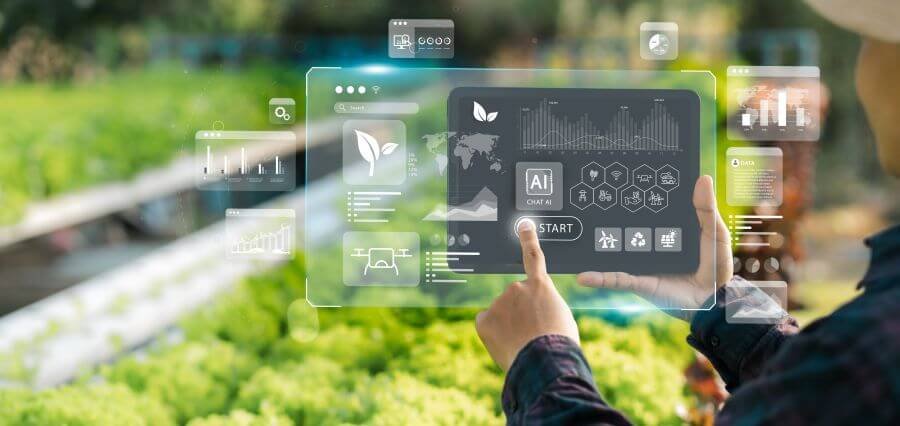
Indian farming has been facing a chain of intricate issues of late—climate change and soil erosion, drought and volatile market prices. With every rise in population, the farmer faces mounting pressure to produce more with less. But amidst all the blues, a benevolent rescuer has arrived on the scene: artificial intelligence. The growing application of AI in Agriculture is transforming the way of agriculture, providing a new ray of hope for crores of farmers globally and also in India.
The Conventional Problems in Farming
Agriculture has itself been a hazardous vocation to become engaged in in the first place. Farmers are forced to make decisions by the minute based on variables such as weather, bugs, and price that are constantly changing. Small errors can lead to crop loss and financial setbacks. In India, where major portions of the population eke out a living through agriculture, these are economic risks, to be sure, but personal and public risks as well.
Issues such as declining soil quality, lack of access to advanced technologies, untrained manpower, and poor post-harvest infrastructure still affect productivity. These issues cannot be addressed through conventional solutions only. It is here that AI in Agriculture comes with new data-driven approaches.
What Is AI in Agriculture?
“Agricultural AI” refers to the use of artificial intelligence technologies—i.e., machine learning, computer vision, robotics, predictive analytics—to automate and streamline farm operations. Seeds to harvest, AI software programs can browse vast amounts of data to enable farmers to make quicker, improved, and more accurate decisions.
These technologies are saving on waste, augmenting yield, and cutting costs. Above all, they’re providing farmers with real-time data that would otherwise be unobtainable without expert knowledge or the availability of expensive equipment.
Applications of AI in Agriculture in Real Life
Precision Farming
One of the most important uses of AI in Agriculture is precision farming. Fields are equipped with sensors that measure moisture, soil conditions, temperature, and crop health. AI translates this information to alert farmers to useful facts—such as the amount of water or fertilizer required in a specific area. Precision application saves wastage and increases efficiency.
Crop Monitoring and Disease Detection
Computer vision-equipped drones and computer vision-triggered artificial intelligence can scan broad fields of crops to find proof of pest infestation or disease way before the naked eye can. Early detection means early action, which reduces crop loss significantly.
Weather Forecasting
Artificial intelligence software uses past as well as current data to provide hyperlocal weather forecasts. Farmers are able to plan sowing, watering, and harvesting activities better—preventing damage by weather.
Automatic Irrigation and Robotic Solutions
AI-based smart irrigation supplies water where and when it is needed. Robotic harvesters and weeders reduce or even eliminate the need for labor, saving money and improving efficiency.
Market Analysis and Price Predictions
On the basis of market trends and past history, AI in Agriculture software can predict commodity prices and suggest the best time to sell the produce. Farmers can thereby avoid distress sales and get better returns on their produce.
How AI Benefits the Indian Farmer
Usage of AI in Agriculture is especially radical in India, since the majority of farmers own marginal or small farms. Applications of AI—most of which are now available in the form of mobile apps in the vernacular languages—make small farmers feel the generosity of advanced technology.
For example, the likes of Microsoft’s AI Sowing App and IBM’s Watson Decision Platform are already being applied in Indian states like Andhra Pradesh and Maharashtra. These tools provide farmers with crop advisories specific to the local situation, allowing them to make better decisions with less guesswork involved.
Challenges and the Road Ahead
While the benefits of AI in Agriculture are apparent, there are still barriers to its widespread adoption. Digital illiteracy, lack of suitable internet connectivity in rural areas, and costly nature of some of the technology are close to the top of the list of worries. Nevertheless, with increasing alignment between government efforts and agri-tech start-ups, barriers are being overcome slowly.
Public-private collaborations, investment in AI-powered solutions, and public campaigns are necessary to take the potential of AI to rural India from all directions.
Conclusion
The agriculture of the future is data and technology. With the farming sector yet to fully convert to modernity, AI in Agriculture is being a game-changer—offering more intelligent ways of producing food, reducing risk, and improving farmers’ lives. It’s not just about efficiency or yield—it’s giving back the dignity and sustainability to one of humanity’s most ancient professions.
With continuous innovation and proper support, AI in Agriculture will be a solution to some of the most significant challenges of agriculture that farmers are facing today and tomorrow.
Read Also : Digital Healthcare: Telemedicine and AI Clinics in Rural Maharashtra